
Wood stoves have existed for centuries, but that does not mean the technology has stood still. A modern wood stove is a technical masterpiece, designed to extract as much energy as possible from wood. Where older models from around 20 years ago barely reached an efficiency of 30%, a Leenders stove effortlessly achieves 80 to 90%. How is that possible? You can read all about it on this page.
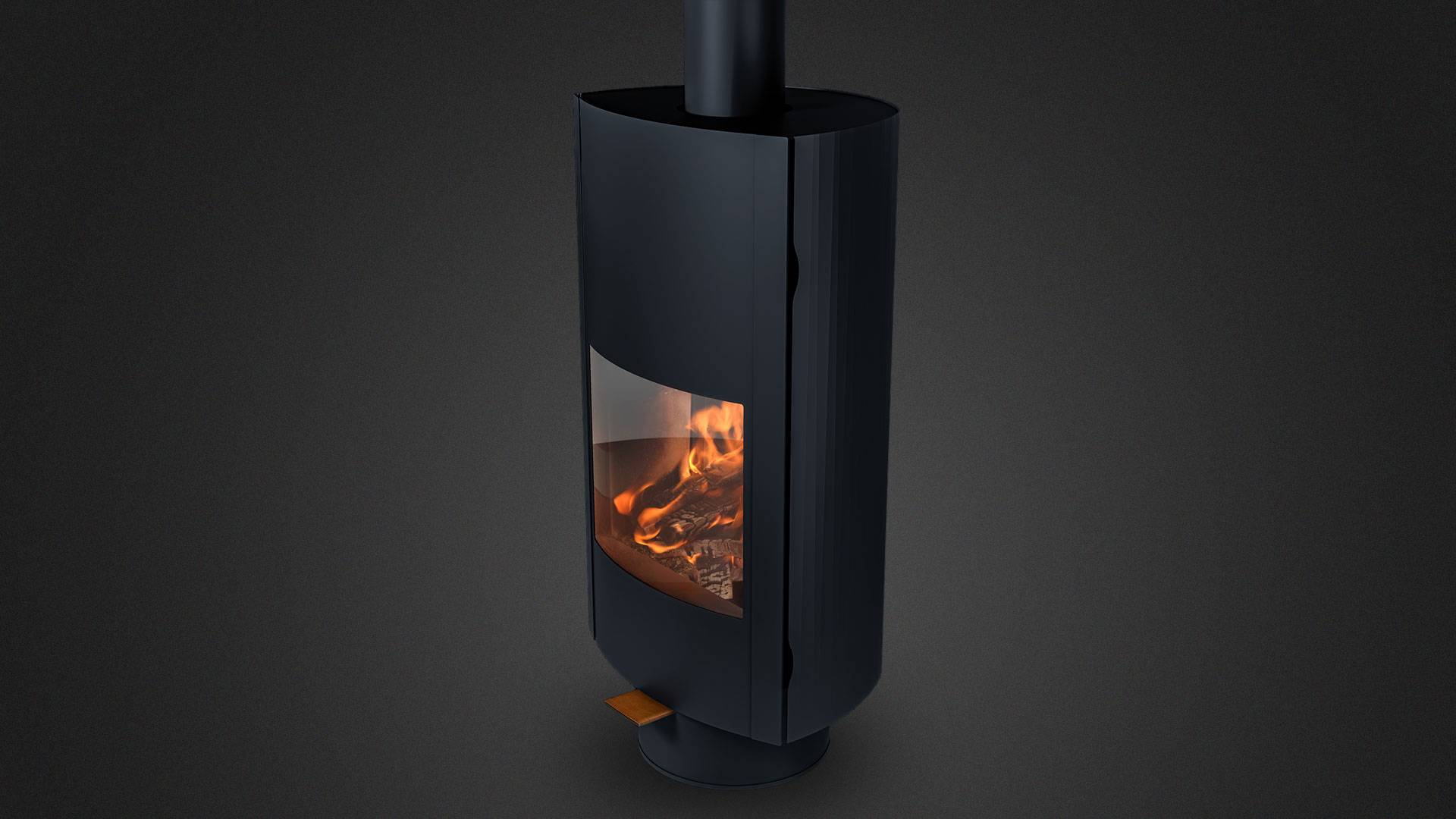
This is where it happens. This is where the fire lives. The fire chambers of a Leenders wood stove are designed so that the fire not only burns beautifully, but is also actively supported.
In older stoves, the gases released during the primary combustion of the wood leave the fire chamber immediately through the chimney. That is a waste. In our modern wood stoves, these flue gases are burned again higher up in the fire chamber. This is known as secondary combustion. It results in higher efficiency and cleaner emissions. Thanks to this, a particle filter is not required for our wood stoves. In fact, such a filter would reduce efficiency.
Fire needs air. And it receives it at exactly the right moment and in the right place. Our wood stoves are equipped with air controls that allow you to regulate the air supply. When lighting the fire, you fully open these controls to get the fire going properly. Once the fire is burning well, you can partially close them to optimise heat output.
The air flows towards the fire and, via a smart detour, upwards in the fire chamber. This allows the stove to reach operating temperature quickly and optimises secondary combustion. Once the wood stove is up to temperature, a natural air circulation is created that preheats the incoming air. In the illustration below, the blue lines show the air supply inside the stove.
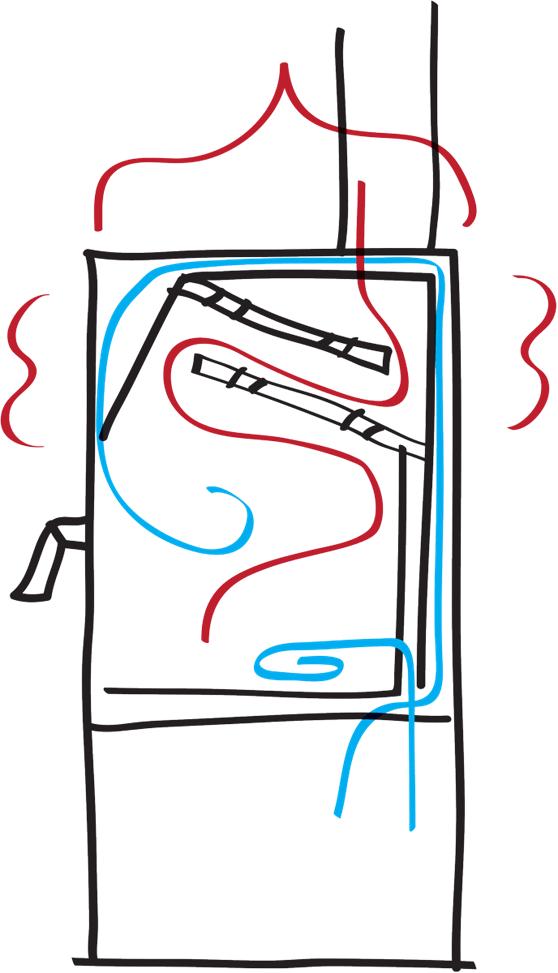
In addition, the fire now also receives heat from the heat shield and the rear wall. This further contributes to efficient combustion and a high level of efficiency.
Some of our models use a concentric flue system. With this system, fresh outside air is drawn in through a separate duct. This results in even better combustion and even higher efficiency.
Modern wood stoves heat a room in two ways: convection heat and radiant heat. Convection heat warms the air, causing warm air to rise and cooler air to sink. This continuous circulation ensures even and efficient heating of the space. Radiant heat does not heat the air, but directly warms people and objects in a room. This happens through infrared radiation, similar to the warmth of the sun. Radiant heat often feels very comfortable because it is immediately noticeable and does not cause air movement.
The heat output of our wood stoves is optimised and extended thanks to the outer stone cladding or the plus stone set. Once the interior of the stove has reached temperature, the stones are heated as well. These stones are made of prisolite, a unique combination of concrete and fibres that stores heat and releases it slowly into the room. This allows you to heat a space for a longer period using the same amount of wood. Highly efficient indeed.
Thanks to these smart technologies, modern wood stoves achieve a high efficiency while keeping emissions of harmful substances to a minimum. Our high efficiency wood stoves therefore comfortably meet the EcoDesign 2022 standards, which require a minimum efficiency of 75% and a maximum fine dust emission of 40 milligrams per cubic metre. You can see this clearly in this table.